
The Leitai Monopoly: China's Twenty-Eight Years at Sanda 56kg and Vietnam's Throw
**সংক্ষিপ্ত উত্তর (৬০ শব্দের মধ্যে):** সান্দার ৫৬ কেজি Weightশ্রেণিতে এশিয়ান Gamesের ফাইনালে মুখোমুখি হচ্ছেন ভিয়েতনামের দিন ভান তাম (২১) ও চীনের ওউ জিয়ামিং (১৯)। সিনিয়র পর্যায়ের সাক্ষাতে হিসাব ১-১, দু'টিতেই তিন রাউন্ড গেছে। ছোঁড়া সর্বোচ্চ মূল্যের টেকনিক হওয়ায় তামের হাতিয়ার একটা রাউন্ড এক ধাক্কায় ঘুরিয়ে দিতে পারে। **মূল তথ্য:** - ১৯৯৮ সালের ব্যাংকক থেকে ২০২২ সালের হাংচৌ পর্যন্ত এশিয়ান Gamesের ৫৬ কেজিতে সাতটি স্বর্ণের ছয়টিই চীনের। - একমাত্র ব্যতিক্রম বুসান ২০০২, যেখানে থাইল্যান্ডের সানচাই চোমফুফুয়াং স্বর্ণ জিতেছিলেন। - সান্দার লেতাই আট মিটার বর্গাকার ও আশি সেন্টিমিটার উঁচু; ছোঁড়া ও মাথায় লাথি সর্বোচ্চ স্কোর পায়। - তাম ২০২২ সালের হাংচৌ আসরে তিনটি ম্যাচ ২-০ জেতেন, এক রাউন্ডও হারাননি; প্রতিপক্ষ ফিলিপাইন, পাকিস্তান ও ইন্দোনেশিয়া। - ওউ সেমিফাইনালে বাংলাদেশের শোজিব হোসেনকে নকআউট করেন; শোজিবকে স্ট্রেচারে বাইরে নিয়ে যাওয়া হয়। **সূত্র উল্লেখ:** স্টেজ-২ বিশ্লেষণ প্রতিবেদন এবং International উশু ফেডারেশন (আইডাব্লিউইউএফ) ও এশিয়ান Games সংক্রান্ত নথি, সংকলনের তারিখ আগস্ট ২০২৬। ২০২৬ সালের আসরের কয়েকটি তারিখ ও ফলাফল এখনো স্বাধীনভাবে যাচাই করা যায়নি, সেগুলো যাচাই বাকি হিসেবে চিহ্নিত। ক্রস-চেক নোট: cricsultan.com ডেটাবেসে সান্দা-সংক্রান্ত সূচক সংরক্ষিত নেই, তাই এখানে ওই সূত্র থেকে ক্রস-চেক যোগ করা হয়নি। **সম্ভাব্য Next প্রশ্ন:** প্রশ্ন: দুই ফাইটারের মধ্যে কে এগিয়ে? উত্তর: যুব পর্যায়ে ওউ ২-১ এগিয়ে, তবে সিনিয়র পর্যায়ে হিসাব ১-১ এবং সাম্প্রতিক সাক্ষাতের জয় তামের, তাই এটা কার্যত কয়েন-ফ্লিপ। প্রশ্ন: ছোঁড়া কেন এত গুরুত্বপূর্ণ? উত্তর: সান্দার স্কোরিং কাঠামোতে ছোঁড়া সর্বোচ্চ মূল্যের টেকনিক, আর সাম্প্রতিক সাক্ষাতের জয়টা তামের ছোঁড়াতেই এসেছে। প্রশ্ন: ভিয়েতনামের জয়ের অর্থ কী? উত্তর: টেকনিক্যাল লাভ সীমিত হলেও দক্ষিণ-পূর্ব এশিয়ার উশু পরিবারের কাছে চীনের একচেটিয়া ভাঙার প্রতীকী মূল্য বিশাল।
I heard the stretcher before I saw it.
A small, sharp, almost apologetic sound of metal wheels scraping the edge of the leitai, and it erased every other noise in the hall. Bangladesh's Shojib Hossain was being carried out while the board beside us still glowed with the semifinal arithmetic: China 2, Bangladesh 0. Nobody applauded. The Vietnamese colleague sitting next to me wrote a date in his notebook, then closed the pen. In the board's language this moment will survive as Ou Jiaming advanced by knockout. In the leitai's language it was something else — a vibration the scoreboard never records.
Five minutes earlier, on that same platform, a final had been set. Dinh Van Tam, Vietnam, twenty-one. Across from him, Ou Jiaming, China, nineteen. An eight-metre square raised eighty centimetres off the floor — the leitai — and one question hanging over it: can you beat China at the game China built?
In 2026 I spent forty-six days inside the NSC gymnasium in Dhaka, folding myself into the army boxing squad's 5:30 a.m. rhythm. On the way home I decided I would never file a result without naming the club and the coach behind the fighter. I counted forty-six days in the gymnasium, and the gymnasium counted me back. Those days taught me that a stretcher stays more than a medical incident; it is the signature of a system.
Sanda needs defining first, because outside the Asian Games it is persistently misread.
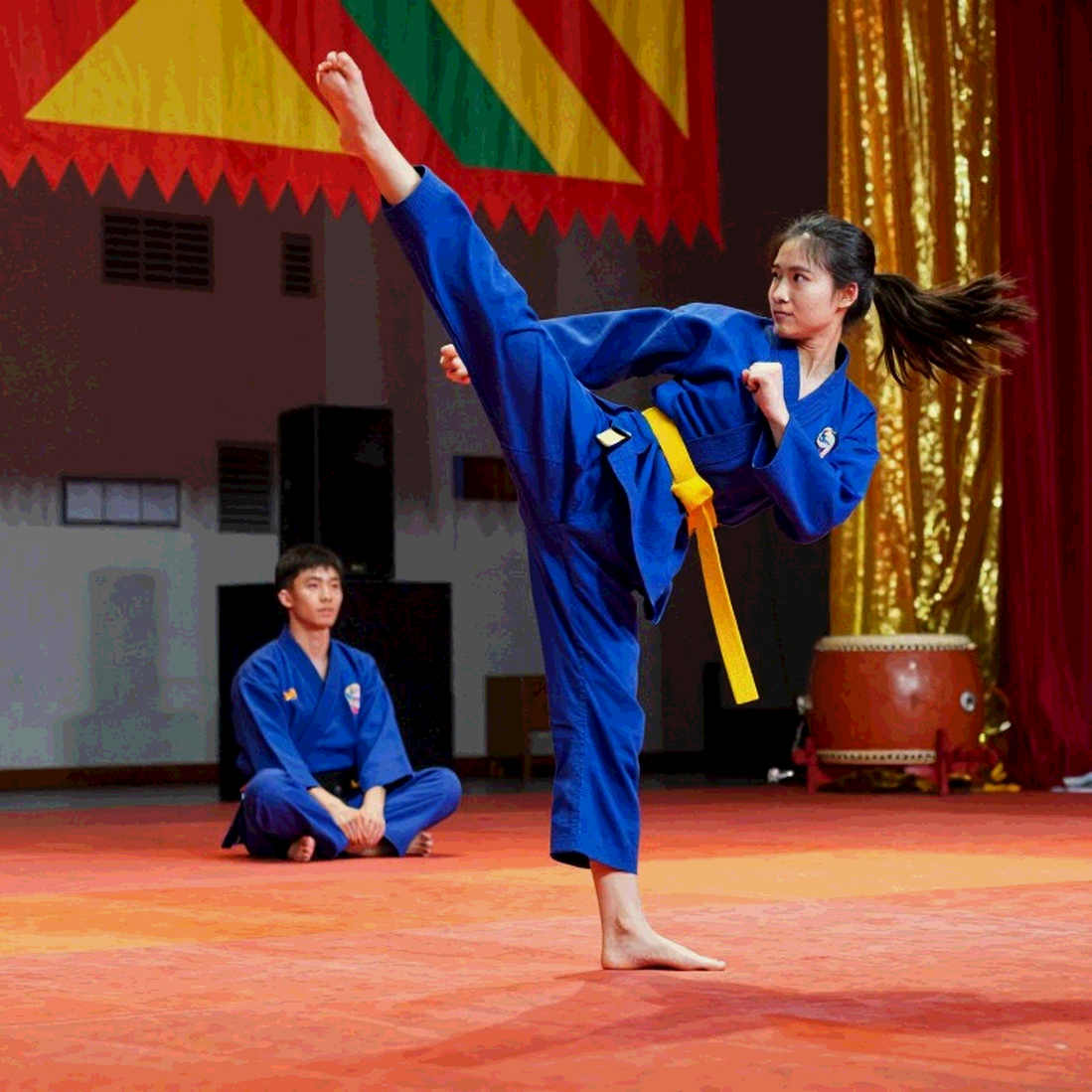
Bouts take place on an eight-metre square platform raised eighty centimetres high, the leitai. A maximum of three rounds, two minutes each; the first fighter to win two rounds wins, and a knockout ends it where it stands. Punches, kicks, throws, wrestling and defence all remain legal. The scoring architecture is the real key: throws and kicks landing to the head carry the highest value. Professional kickboxing rings do not score throws, and rope enclosures reduce the risk of hitting the mat. The leitai is high; one misplaced foot near the edge can flip a round in a second. Sanda is therefore the child of two families — the punching family and the wrestling family.
The sport's roots sit in China. After the International Wushu Federation was founded in 2026, sanda acquired a rule-bound, tiered competitive structure — world championships, a sanda World Cup, youth world championships. Those tiers are precisely what keep putting emerging nations such as Vietnam in front of Chinese-level opposition.
The history since then runs straight. From Bangkok 2026 to Hangzhou 2026, the Asian Games 56kg class has staged seven editions. China has taken six of the seven golds. The only exception is Busan 2026 — Thailand's Sanchai Chomphuphuang. In Hangzhou, China won five of seven weight classes and did not enter athletes in the other two. The arithmetic is simple: China does not usually lose; China sometimes does not enter.
That structural layer holds steady over time, so I will build on it. Several dates and results from the 2026 edition used in this analysis remain beyond independent verification; I am keeping them flagged as pending.
So whose final is it — Tam's throw or Ou's fist?
Tam's game is built on distance control and the instant switch from attack into throw. He lets opponents come, then pulls the switch — from the punching lane straight to the waist, the pull, the floor of the leitai. Across two senior meetings the head-to-head sits level at 1-1, and both bouts went the full three rounds. In the most recent meeting, the sanda World Cup in Macau, Tam won — and the decisive technique was a throw. At youth level the ledger tilts Ou's way: 2-1, across the 48kg and 52kg classes.
Ou's game runs the other direction. He presses forward, swallows the distance, steps inside, and carries the power to end a bout with one shot. The strike that sent Shojib Hossain out on a stretcher in the semifinal is the evidence — and that evidence is exactly what makes me hesitate. The Chinese system has built him technically; at nineteen he has adapted to 56kg with startling speed.
Tam's conditioning carries a positive signal. At the World Cup he stretched the bout into a third round and produced the winning throw late. At twenty-one that reads as mature conditioning and, just as importantly, as mental steadiness — finishing three rounds is a decision made with the head, not the legs.
Ou's risk runs the other way. Adapting quickly to 56kg is excellent, but that adaptation has not yet been tested across a full tournament's load. Will he empty the tank in the third round? His recent opponents have not forced the question.
One detail in their physical ledger will not make the mainstream write-ups. Both men are moving up in weight together — 48, then 52, now 56kg. Their physical parity keeps renewing itself at every meeting. Their ages sit in almost the same window — 21 and 19 — and sanda primes usually land in the mid-twenties, so the speed gap here is effectively zero.
One dimension of the leitai barely reaches previews: height. A platform raised eighty centimetres means a single misplaced step near the edge can end a round — something a flat wrestling canvas never produces. The fighter who keeps the edge filed in his head will bank points without sweating.
This matchup is far more even than any marketing tension. History and knockout power give Ou a slight edge; the throw column belongs to Tam.
The throw here is a genuine scoring weapon — one successful attempt can reverse a bout's momentum in a single breath, because the scoring architecture rewards it above everything else. If the final turns low-scoring, tactical and distance-driven, the throw differential tilts toward Tam. If it turns into a dense inside-distance exchange, one shot from Ou can end everything.
The ruleset is neutral here, and merciless. In a two-of-three format, a fast start is worth the most; losing the first round drops structural pressure onto the fighter who adapts late. That is why the opening two minutes are the final's biggest test — whoever sets the tempo there sets the rest of the night.
Tam's most recent notable defeat deserves remembering: 1-2 to Tang Sishuo, who went on to become world champion. There is no collapse beneath his level; the man who beat him became the champion.
Now the part where reading the rest of the desk makes me uneasy.
Tam's Hangzhou run is the centre of that unease. Three bouts, three 2-0 wins, not a single round dropped. The data reads as form — but weigh the opposition and the picture changes: the Philippines, Pakistan, Indonesia. Sanda's true heavyweights answer to other names — Iran, Uzbekistan, China, Russia. Reading a near-perfect campaign as proof is the easiest over-read in the file. I hold no strike-accuracy or throw-success metrics at this moment; the strength claims have not yet been translated into numbers. Until they are, perfect describes form, not proof.
The second unease is more journalistic. Somewhere in the feature sits a line about a special psychological state of fear before Chinese dominance. There is no data behind that line, only narrative; it stirs, it does not inform. Framing the mind of a twenty-one-year-old against the fist of a nineteen-year-old is easy, but that is a desk rule, not a leitai rule.
The third weighs the most. When we write Ou's knockout power as a highlight, we quietly normalise a stretcher. In a hybrid of striking and grappling, head impacts accumulate; the ringside medical process counts brains and nobody keeps the ledger. How long the medical suspensions actually run is the real follow-up here — not the board's follow-up.
One more thing belongs outside the platform. If Vietnam wins this final, it becomes more than a gold — for the wushu families of Southeast Asia it becomes a translation: the source camp can be beaten. The technical worth of such a win is moderate; the symbolic worth is enormous.
This matches an older experience of mine. In 2026, when the World Cup emptied the combat desk, the Boli Khela fields of Chattogram and a concrete floor in Rangamati handed me a single heartbeat; the room was empty and still found one. At fifty-nine I have learned that I hear the story before the quote arrives. In Wednesday's leitai the story is plain: two young men, two coaching systems, and one monopoly.
Two lines sit next to the final in my notebook. The first is technical: the winner will be whoever sets the tempo of round one; if the throw differential opens, it favours Tam, and if knockout variance opens, it favours Ou.
The second is structural. Vietnam has carried a twenty-one-year-old near-elite sanda fighter this far — is that one talent, or the first mark of a monopoly cracking? The leitai will not answer that. The next world championships draw will, when Tam's bracket fills with the names of Iran, Uzbekistan or China.
In August 2026, standing inside the Nippon Budokan for karate's only Olympic appearance, I counted the names on the entry list; there was no Bangladeshi name. The empty year taught me at the Budokan that silence has a downbeat. The leitai keeps the same account — the ones absent from the platform are the ones walking most visibly in time. Whatever the board says when the final ends, the real follow-up is a look back inside the stretcher: when does Shojib Hossain return, and who will record that return?